Compare interpolation methods
In this notebook we do spatial interpolation of CML rainfall data and compare IDW and Kriging, each with different parameters. Before we can do the spatial interpolation we first have to process the example CML data.
[1]:
import pycomlink as pycml
import matplotlib.pyplot as plt
import matplotlib as mpl
import numpy as np
import pandas as pd
import xarray as xr
/Users/chwala-c/code/pycomlink/pycomlink/io/examples.py:1: UserWarning: pkg_resources is deprecated as an API. See https://setuptools.pypa.io/en/latest/pkg_resources.html. The pkg_resources package is slated for removal as early as 2025-11-30. Refrain from using this package or pin to Setuptools<81.
  import pkg_resources
Load example CML data
[2]:
cmls = xr.open_dataset(pycml.io.examples.get_example_data_path() + '/example_cml_data.nc')
cmls
[2]:
<xarray.Dataset> Size: 254MB
Dimensions:           (channel_id: 2, cml_id: 500, time: 15840)
Coordinates:
  * time              (time) datetime64[ns] 127kB 2018-05-10 ... 2018-05-20T2...
  * cml_id            (cml_id) <U3 6kB '0' '1' '2' '3' ... '497' '498' '499'
    length            (cml_id) float64 4kB ...
    site_a_latitude   (cml_id) float64 4kB ...
    site_a_longitude  (cml_id) float64 4kB ...
    site_b_latitude   (cml_id) float64 4kB ...
    site_b_longitude  (cml_id) float64 4kB ...
  * channel_id        (channel_id) <U9 72B 'channel_1' 'channel_2'
    frequency         (cml_id, channel_id) float64 8kB ...
    polarization      (cml_id, channel_id) <U1 4kB ...
Data variables:
    rsl               (channel_id, cml_id, time) float64 127MB ...
tsl (channel_id, cml_id, time) float64 127MB ...Set fill values to NaN and interpolate short gaps
[ ]:
cmls['tsl'] = cmls.tsl.where(cmls.tsl != 255.0)
cmls['rsl'] = cmls.rsl.where(cmls.rsl != -99.9)
cmls['trsl'] = cmls.tsl - cmls.rsl

cmls['trsl'] = cmls.trsl.interpolate_na(dim='time', method='linear', max_gap='5min')
Do standard processing
We do a standard processing in this notebook without any explanation to quickly get CML rainfall estimates for interpolaton. For more details on the processing, check out the notebook on the basic CML processing workflow.
[4]:
cmls['wet'] = cmls.trsl.rolling(time=60, center=True).std(skipna=False) > 0.8

cmls['wet_fraction'] = (cmls.wet==1).sum(dim='time') / len(cmls.time)

cmls['baseline'] = pycml.processing.baseline.baseline_constant(
    trsl=cmls.trsl,
    wet=cmls.wet,
    n_average_last_dry=5,
)
cmls['waa'] = pycml.processing.wet_antenna.waa_schleiss_2013(
    rsl=cmls.trsl,
    baseline=cmls.baseline,
    wet=cmls.wet,
    waa_max=2.2,
    delta_t=1,
    tau=15,
)
cmls['A'] = cmls.trsl - cmls.baseline - cmls.waa

cmls['A'].values[cmls.A < 0] = 0

cmls['R'] = pycml.processing.k_R_relation.calc_R_from_A(
    A=cmls.A, L_km=cmls.length.values.astype('float'), f_GHz=cmls.frequency/1e9, pol=cmls.polarization
)
Aggregate to hourly rainfall sums
We do this by taking the hourly mean of the 1-minute rainfall rates of the CML data
[5]:
cmls_R_1h = cmls.R.resample(time='1h', label='right').mean().to_dataset()
cmls_R_1h
[5]:
<xarray.Dataset> Size: 2MB
Dimensions:           (cml_id: 500, channel_id: 2, time: 264)
Coordinates:
  * cml_id            (cml_id) <U3 6kB '0' '1' '2' '3' ... '497' '498' '499'
    length            (cml_id) float64 4kB 6.179 5.673 7.52 ... 14.57 4.994
    site_a_latitude   (cml_id) float64 4kB 58.26 58.09 58.19 ... 57.77 57.07
    site_a_longitude  (cml_id) float64 4kB 1.388 1.637 1.359 ... 1.471 2.09
    site_b_latitude   (cml_id) float64 4kB 58.25 58.13 58.21 ... 57.83 57.07
    site_b_longitude  (cml_id) float64 4kB 1.304 1.59 1.461 ... 1.298 2.023
  * channel_id        (channel_id) <U9 72B 'channel_1' 'channel_2'
    frequency         (cml_id, channel_id) float64 8kB 2.491e+10 ... 2.598e+10
    polarization      (cml_id, channel_id) <U1 4kB 'V' 'V' 'H' ... 'V' 'V' 'V'
  * time              (time) datetime64[ns] 2kB 2018-05-10T01:00:00 ... 2018-...
Data variables:
R (channel_id, cml_id, time) float64 2MB 0.0 0.0 ... 0.0 0.0Calculate center point of each CML
We need this for the simple interpolatoin approaches that are used in this notebook which do simple interpolation of the rainfall values based on the center point of each CML.
[6]:
cmls_R_1h['lat_center'] = (cmls_R_1h.site_a_latitude + cmls_R_1h.site_b_latitude)/2
cmls_R_1h['lon_center'] = (cmls_R_1h.site_a_longitude + cmls_R_1h.site_b_longitude)/2
Function definition for quick plotting of CML paths
[7]:
def plot_cml_lines(ds_cmls, ax):
    ax.plot(
        [ds_cmls.site_a_longitude, ds_cmls.site_b_longitude],
        [ds_cmls.site_a_latitude, ds_cmls.site_b_latitude],
        'k',
        linewidth=1,
    )
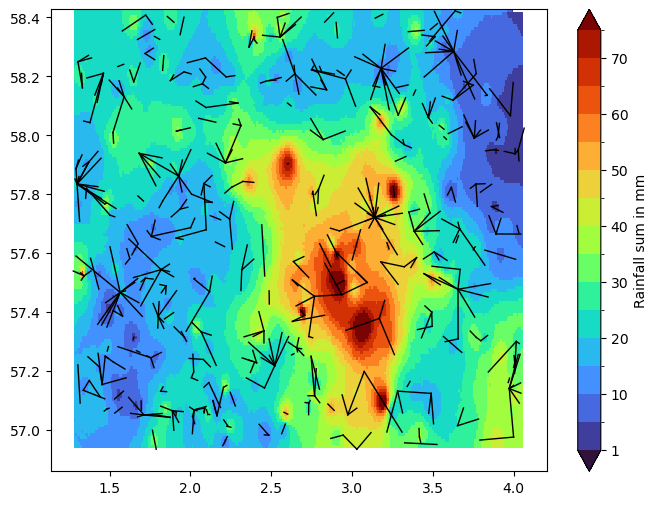
Do interpolation with IDW for rainfall sum per CML over example period
The folowing cell prepares the interpolator object.
[8]:
idw_interpolator = pycml.spatial.interpolator.IdwKdtreeInterpolator(
    nnear=15,
    p=2,
    exclude_nan=True,
    max_distance=0.3,
)
Do the interpolation by calling the interpolator object.
[9]:
R_grid = idw_interpolator(
    x=cmls_R_1h.lon_center,
    y=cmls_R_1h.lat_center,
    z=cmls_R_1h.R.isel(channel_id=1).sum(dim='time').where(cmls.isel(channel_id=1).wet_fraction < 0.3),
    resolution=0.01,
)
[10]:
bounds = np.arange(0, 80, 5.0)
bounds[0] = 1
norm = mpl.colors.BoundaryNorm(boundaries=bounds, ncolors=256, extend='both')

fig, ax = plt.subplots(figsize=(8, 6))
pc = plt.pcolormesh(
    idw_interpolator.xgrid,
    idw_interpolator.ygrid,
    R_grid,
    shading='nearest',
    cmap='turbo',
    norm=norm,
)
plot_cml_lines(cmls_R_1h, ax=ax)
fig.colorbar(pc, label='Rainfall sum in mm');
Compare IDW and Kriging for different parameters
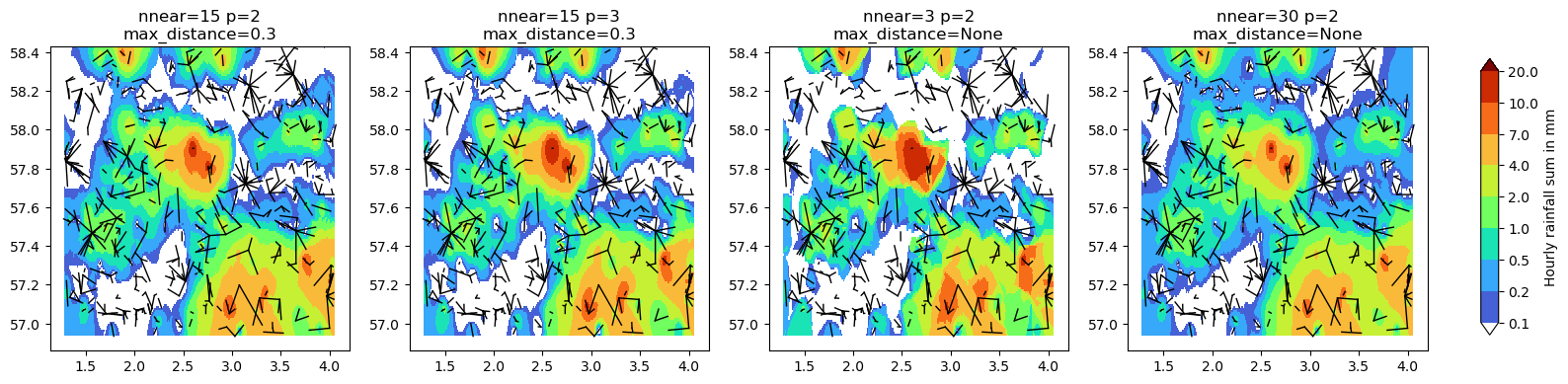
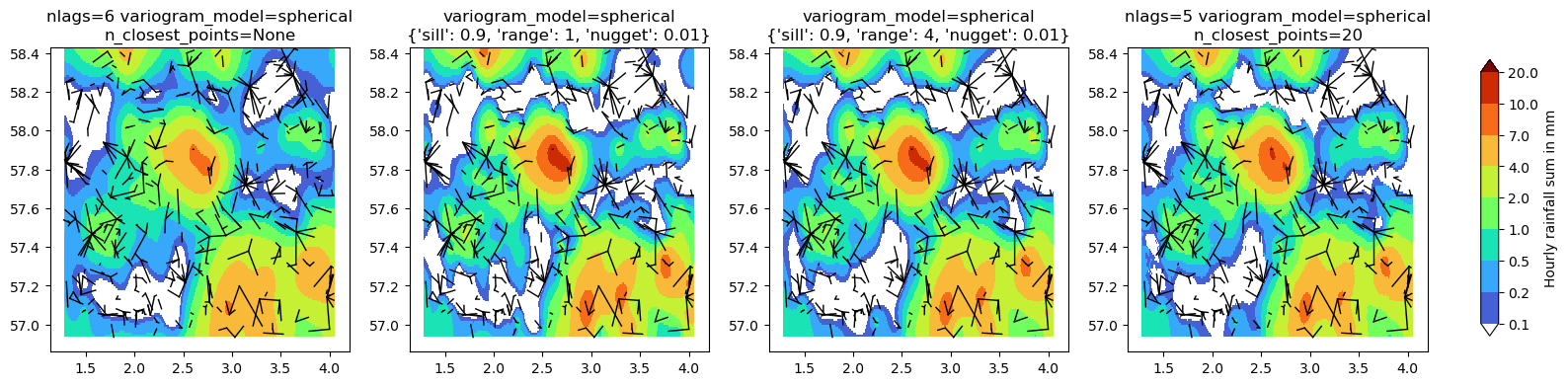
Here we use CML rainfall sum for one hour. Note that we exclude (by setting their result to NaN) CMLs that have a too high (0.3) wet_fraction.
[11]:
cmls_hour_selected = cmls_R_1h.R.isel(channel_id=1).isel(time=92).where(cmls.isel(channel_id=1).wet_fraction < 0.3)
The following cell defines the plotting functions and the colorscale
[12]:
bounds = [0.1, 0.2, 0.5, 1, 2, 4, 7, 10, 20]
norm = mpl.colors.BoundaryNorm(boundaries=bounds, ncolors=256, extend='both')
cmap = plt.get_cmap('turbo').copy()
cmap.set_under('w')


def idw_interpolate_and_plot(ax, nnear=15, p=2, max_distance=0.3):

    idw_interpolator = pycml.spatial.interpolator.IdwKdtreeInterpolator(
        nnear=nnear,
        p=p,
        exclude_nan=True,
        max_distance=max_distance,
    )

    R_grid = idw_interpolator(
        x=cmls_R_1h.lon_center,
        y=cmls_R_1h.lat_center,
        z=cmls_hour_selected,
        resolution=0.01,
    )

    pc = ax.pcolormesh(
        idw_interpolator.xgrid,
        idw_interpolator.ygrid,
        R_grid,
        shading='nearest',
        cmap=cmap,
        norm=norm,
    )
    ax.set_title(f'nnear={nnear} p={p}\nmax_distance={max_distance}')

    plot_cml_lines(cmls_R_1h, ax=ax)
    return pc


def kriging_interpolate_and_plot(
    ax,
    nlags=6,
    variogram_model='spherical',
    n_closest_points=None,
    variogram_parameters=None,
):

    kriging_interpolator = pycml.spatial.interpolator.OrdinaryKrigingInterpolator(
        nlags=nlags,
        variogram_model=variogram_model,
        variogram_parameters=variogram_parameters,
        weight=True,
        n_closest_points=n_closest_points,
    )

    R_grid = kriging_interpolator(
        x=cmls_R_1h.lon_center,
        y=cmls_R_1h.lat_center,
        z=cmls_hour_selected,
        resolution=0.01,
    )

    pc = ax.pcolormesh(
        idw_interpolator.xgrid,
        idw_interpolator.ygrid,
        R_grid,
        shading='nearest',
        cmap=cmap,
        norm=norm,
    )
    if variogram_parameters is None:
        ax.set_title(f'nlags={nlags} variogram_model={variogram_model}\nn_closest_points={n_closest_points}')
    else:
        ax.set_title(f'variogram_model={variogram_model}\n{variogram_parameters}')

    plot_cml_lines(cmls_R_1h, ax=ax)
    return pc
The code below plots 4 different variants of IDW and Kriging using different parameters.
[13]:
fig, axs = plt.subplots(1, 4, figsize=(18, 4))

idw_interpolate_and_plot(ax=axs[0], nnear=15, p=2, max_distance=0.3)
idw_interpolate_and_plot(ax=axs[1], nnear=15, p=3, max_distance=0.3)
idw_interpolate_and_plot(ax=axs[2], nnear=3, p=2, max_distance=None)
pc = idw_interpolate_and_plot(ax=axs[3], nnear=30, p=2, max_distance=None)

fig.subplots_adjust(right=0.9)
cbar_ax = fig.add_axes([0.93, 0.15, 0.01, 0.7])
cb = fig.colorbar(pc, cax=cbar_ax, label='Hourly rainfall sum in mm', );


fig, axs = plt.subplots(1, 4, figsize=(18, 4))

kriging_interpolate_and_plot(ax=axs[0])
kriging_interpolate_and_plot(ax=axs[1], variogram_parameters={'sill': 0.9, 'range': 1, 'nugget': 0.01})
kriging_interpolate_and_plot(ax=axs[2], variogram_parameters={'sill': 0.9, 'range': 4, 'nugget': 0.01})
pc = kriging_interpolate_and_plot(ax=axs[3], nlags=5, variogram_model='spherical', n_closest_points=20)

fig.subplots_adjust(right=0.9)
cbar_ax = fig.add_axes([0.93, 0.15, 0.01, 0.7])
cb = fig.colorbar(pc, cax=cbar_ax, label='Hourly rainfall sum in mm', );
Generate Kriging parameters based on climatological variograms obtained in the Netherlands
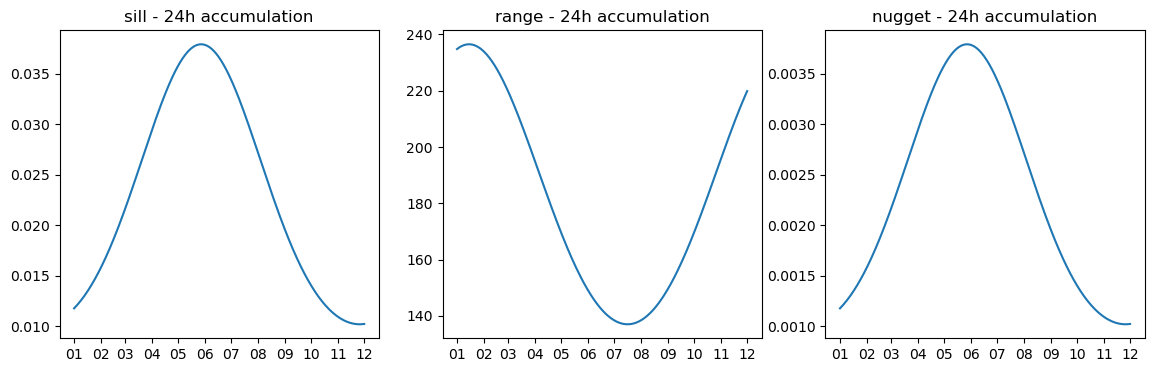
This is based on the variograms obtained in Van de Beek et al., 2012 and the R implementation in RAINLINK by Overeem et al., 2016.
Plot sill, range and nugget for 24h rainfal accumulation
[14]:
# note that the year does not matter here, we only use the julian day inside the function
date_range = pd.date_range('2022-01-01', '2022-12-01', freq='D')

variogram_param_dict_list = []
for date in date_range:
    variogram_param_dict_list.append(pycml.spatial.interpolator.clim_var_param(date_str=date, time_scale_hours=24))

fig, axs = plt.subplots(1, 3, figsize=(14, 4))
for i, var_name in enumerate(['sill', 'range', 'nugget']):
    axs[i].plot(date_range, [variogram_param_dict[var_name] for variogram_param_dict in variogram_param_dict_list])
    axs[i].set_title(f"{var_name} - 24h accumulation")
    axs[i].xaxis.set_major_locator(mpl.dates.MonthLocator(bymonth=range(1,13,1)))
    axs[i].xaxis.set_major_formatter(mpl.dates.DateFormatter('%m'))
Plot sill, range and nugget for 1h rainfall accumulation
[15]:
# note that the year does not matter here, we only use the julian day inside the function
date_range = pd.date_range('2022-01-01', '2022-12-01', freq='D')

variogram_param_dict_list = []
for date in date_range:
    variogram_param_dict_list.append(pycml.spatial.interpolator.clim_var_param(date_str=date, time_scale_hours=1))

fig, axs = plt.subplots(1, 3, figsize=(14, 4))
for i, var_name in enumerate(['sill', 'range', 'nugget']):
    axs[i].plot(date_range, [variogram_param_dict[var_name] for variogram_param_dict in variogram_param_dict_list])
    axs[i].set_title(f"{var_name} - 1h accumulation")
    axs[i].xaxis.set_major_locator(mpl.dates.MonthLocator(bymonth=range(1,13,1)))
    axs[i].xaxis.set_major_formatter(mpl.dates.DateFormatter('%m'))
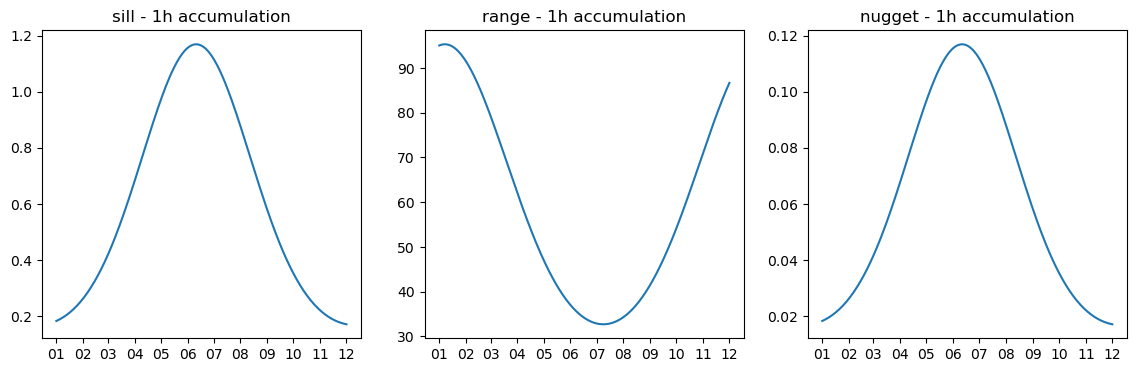
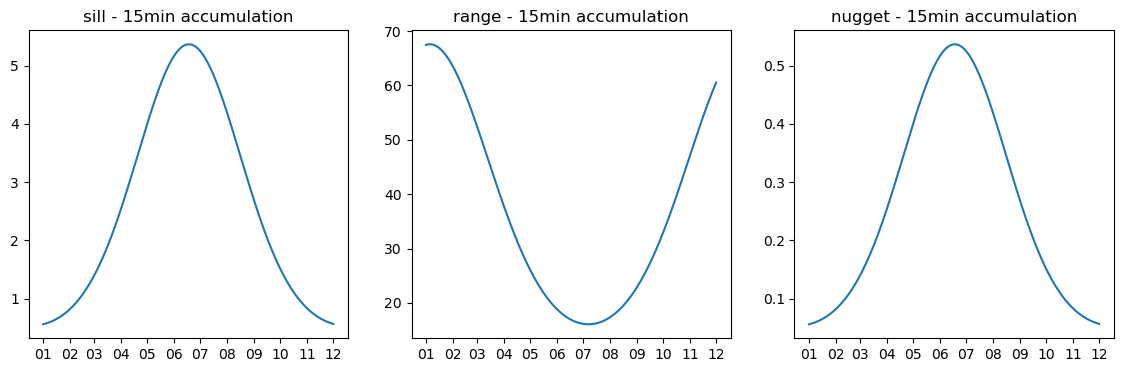
We can also extrapolate for sub-hourly data, e.g. 15 minutes. Note that this is not covered in the original publication by van de Beek et al., 2012 but is also available in the original RAINLINK R code from Overeem et al., 2016.
[16]:
# note that the year does not matter here, we only use the julian day inside the function
date_range = pd.date_range('2022-01-01', '2022-12-01', freq='D')

variogram_param_dict_list = []
for date in date_range:
    variogram_param_dict_list.append(pycml.spatial.interpolator.clim_var_param(date_str=date, time_scale_hours=0.25))

fig, axs = plt.subplots(1, 3, figsize=(14, 4))
for i, var_name in enumerate(['sill', 'range', 'nugget']):
    axs[i].plot(date_range, [variogram_param_dict[var_name] for variogram_param_dict in variogram_param_dict_list])
    axs[i].set_title(f"{var_name} - 15min accumulation")
    axs[i].xaxis.set_major_locator(mpl.dates.MonthLocator(bymonth=range(1,13,1)))
    axs[i].xaxis.set_major_formatter(mpl.dates.DateFormatter('%m'))
[ ]: